
How to Choose a Carrot Processing Line: Washing, Sizing and Packing
A guide to choosing your carrot line: process stages, the ZC 8000 and the ZCR, how to size it and how to handle packing.
Fresh carrots that reach a supermarket shelf or an export container have gone through three stages that need to be perfectly integrated: washing, size classification and packing.
Why mechanize washing and sizing?
- Continuous flow. On the ZC 8000, carrots go from bin to final pack in a single pass.
- Consistent grading. The sizer separates by size according to the commercial matrix you define, always with the same criteria.
- Resources where they pay off. Dry pre-cleaning reduces the dirt reaching the water, and inspection removes roots with serious defects before resources are invested in sizing.
- Steady pace. An accumulation disc absorbs flow peaks and keeps the sizing rate steady.
- Sanitary design. Product-contact surfaces are AISI 304 stainless steel.
The stages of carrot processing
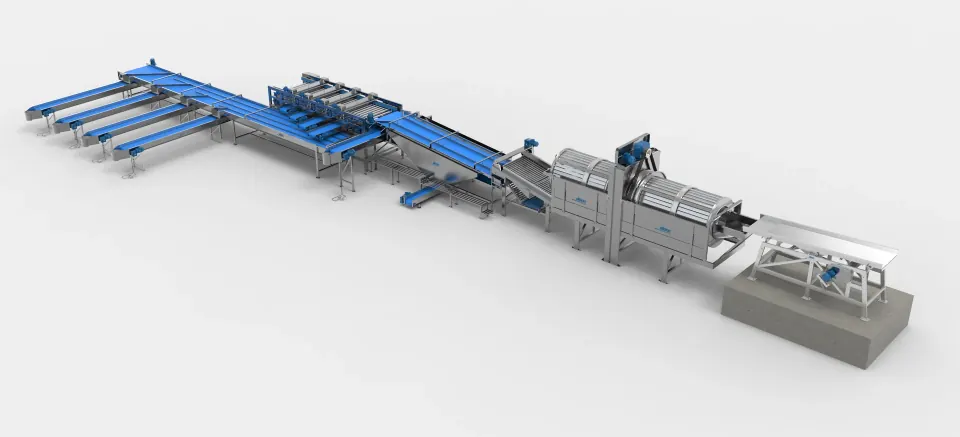
The ZC 8000 integrates 11 machines, from bin to final pack. Grouped by function, the flow looks like this:
Stage 1 — Receiving and washing
- Receiving and Pre-cleaning Screen: separates dry soil and fragments before washing.
- Rotary Washer: a drum with water spray removes the soil adhered to the root.
Stage 2 — Discarding and inspection
- Roller Discard Unit: drops out-of-size carrots and broken pieces through the gaps.
- Inspection Conveyor: operators discard roots with serious defects.
- Lower Discard Conveyor: collects everything separated and takes it off the line.
- Bagging Conveyor for Second Sorting: final commercial sorting station, with bagging on the same conveyor.
Stage 3 — Sizing and packing
- Accumulation Disc and Elevator: absorb flow peaks and carry the flow up to the sizer inlet.
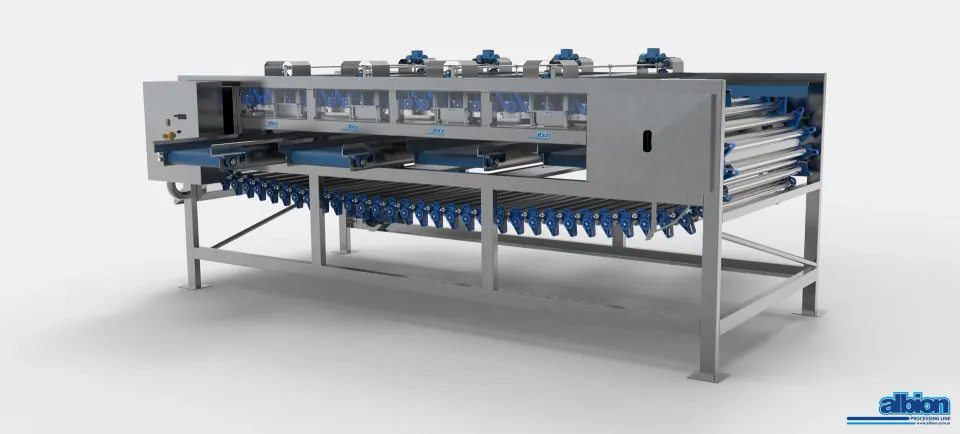
- Sizer: separates carrots by size according to the defined commercial matrix.
- Distribution Conveyor and Final Bagging Conveyor: route each grade to its packing station and deliver the final pack, which can be a bag, net, tray or case.
The two available configurations
Albion manufactures two configurations for carrots. They don’t compete with each other: they answer two different starting points.
| Model | Capacity | What it includes / who it’s for |
|---|---|---|
| ZC 8000 | 6,000–8,000 kg/h | Complete line of 11 machines: pre-cleaning, washing, discarding, inspection, accumulation, sizing and bagging. For large packers and cooperatives. |
| ZCR | To be defined per customer integration | Mechanical roller sizer, as a standalone unit. For plants that already wash and pack and size by hand today. |
ZC 8000: from bin to pack in a single pass
The ZC 8000 is designed for fresh carrots headed to retail or export: it integrates all three stages in a continuous flow, and its outlet adapts to the packaging your customer asks for. Its page shows the 11 machines individually.
ZCR: the reference sizer
The ZCR is a mechanical roller sizer for fresh and industrial carrots, proven in Argentine and Chilean packing houses for decades. Carrots travel along rollers with progressively increasing spacing and drop by gravity when the gap matches their size grade, so they come out classified into multiple output lanes. There are no aggressive contact parts, and maintenance is minimal: the rollers are replaced in sections.
How to choose your configuration
- What do you have in your plant today? If you’re starting from scratch, the reference is the ZC 8000. If you already wash and pack but size by hand, that is your bottleneck: the ZCR automates it and integrates with your existing washing line.
- How much volume do you process? The ZC 8000 runs at 6,000–8,000 kg/h. If your operation is far from that range, tell us about your case before deciding.
If your plant is only missing a transport or visual-inspection step, look at the equipment Albion builds as individual units, such as elevators and inspection conveyors.
Sizing example (orientative)
Annual capacity = hourly capacity × hours per day × days per year
Assumption: standard operation of 8 hours per day × 200 days per year = 1,600 hours per year.
- At 6,000 kg/h, the low end of the ZC 8000: 9,600 tons per year, about 48 tons per day.
- At 8,000 kg/h, the high end: 12,800 tons per year, about 64 tons per day.
The other way around: to process 10,000 tons per year under the same assumption, you need 10,000,000 kg ÷ 1,600 h = 6,250 kg/h on average, within the ZC 8000 range. If that volume had to be processed in half the days, the average rises to 12,500 kg/h, which exceeds the range of a single ZC 8000: in that case, it’s worth reviewing the approach with us.
Important: this is an orientative calculation based on an operating assumption, not a production guarantee. The final proposal is built from your plant’s actual data.
Warranty, pre-assembly, financing and support
- 12-month warranty on mechanical parts of Albion’s own manufacture. It does not cover consumables or damage caused by improper maintenance.
- Pre-assembly: lines ship pre-assembled from Albion’s workshop.
- Financing: many customers finance the investment through Banco Nación credit lines for domestic industrial machinery in Argentina. You handle the application with the bank; Albion issues the documentation.
- Support: after-sales technical support is concentrated in Latin America, but equipment ships anywhere in the world. Albion equipment operates today in 18 countries across 6 continents.
Behind it is a family company from Mendoza, founded in 1966 by Atilio César Dal Pozzo and led today by the second generation, with more than 50 in-house experts.
Next step
- Send us your operation’s data: the volume you process or plan to process, the equipment you have today, how you pack, and your plant’s basic data.
- Review financing through Banco Nación credit lines, if it applies to your case.
See photos and technical details on our carrot lines page, or contact us to start your quote.
Frequently asked questions
- What is the difference between the ZC 8000 and the ZCR?
- The ZC 8000 is a complete line: 11 integrated machines that take carrots from bin to final pack, covering washing, sizing and packing at 6,000–8,000 kg/h. The ZCR is a mechanical roller sizer that Albion offers as a standalone unit, to integrate with a washing and packing line you already have. Its capacity is defined per integration with your plant.
- Can I add just the sizing stage if I already wash and pack?
- Yes, that is what the ZCR is for. It is designed to receive product from your existing washing line and is the incremental investment that automates sizing when you do it by hand today. Since capacity is defined per integration, send us the details of your current line.
- Does the roller sizer damage the carrots?
- The ZCR classifies by gravity: carrots travel along rollers with progressively increasing spacing and drop when the roller gap matches their size grade. It has no aggressive contact parts and no mechanism that could damage the product. The rollers are replaced in sections.
- What does the warranty cover?
- Albion provides a 12-month warranty on mechanical parts of its own manufacture. It does not cover consumables or damage caused by improper maintenance.
- Can the line be financed?
- Many customers finance the investment through Banco Nación credit lines for domestic industrial machinery in Argentina. You handle the application with the bank; Albion issues the documentation you need. Ask about your specific case when you request a quote.
- Does Albion sell its lines outside Argentina?
- Yes. Albion equipment operates in 18 countries across 6 continents. After-sales technical support is concentrated in Latin America, but equipment ships anywhere in the world.
Lines mentioned in this article
Ready to size your processing line for carrots?
Send us your operation's basic data and we'll prepare a proposal sized to your volume and your warehouse.
Request a quote